One unbroken series
A draft has no number. The number is issued at the moment the invoice is, so an abandoned draft never leaves a gap, and the series restarts on 1 April with the financial year.
GST invoicing
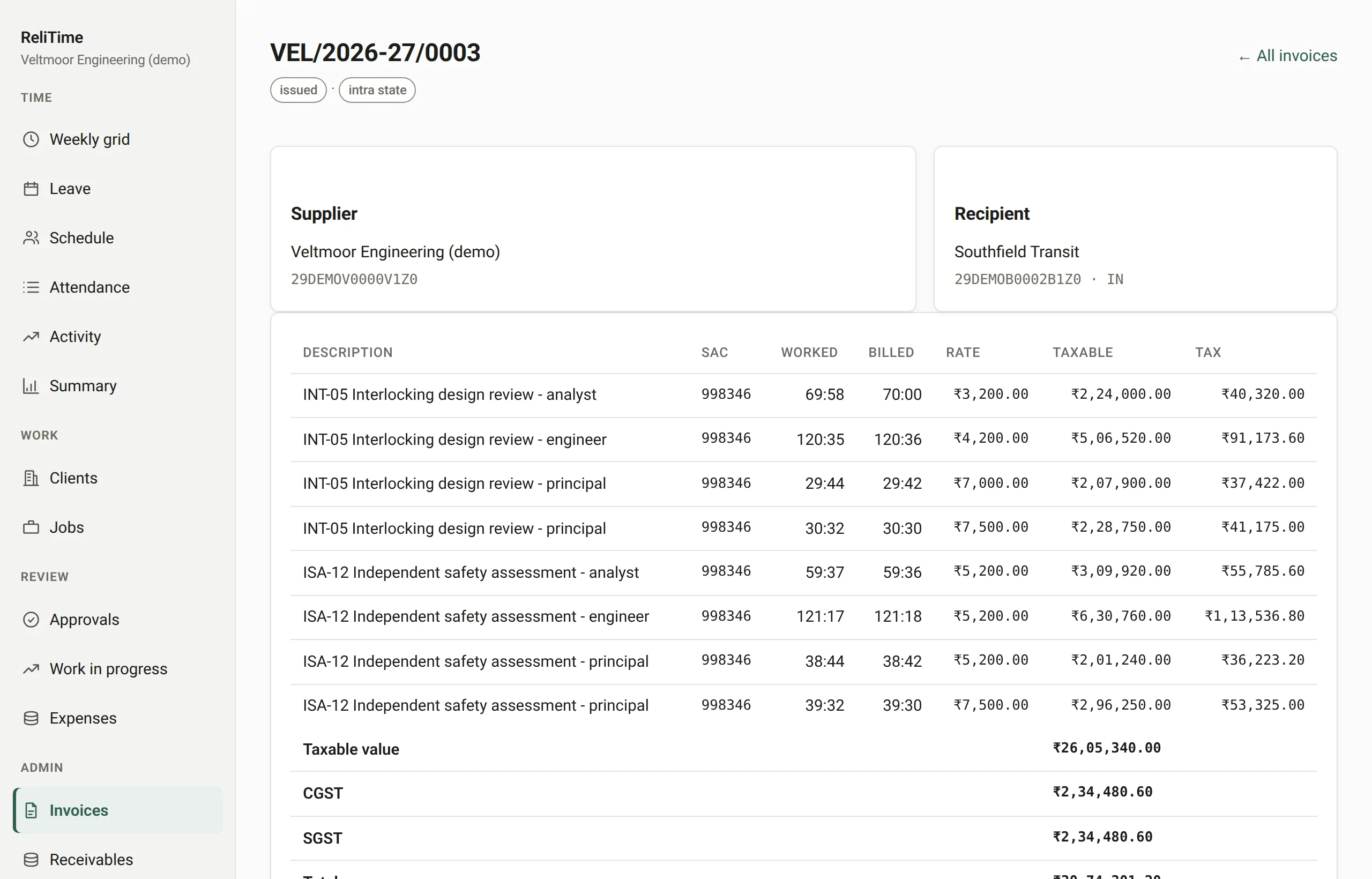
ReliTime raises tax invoices from the hours that were approved and locked, priced at the rates in force when they were worked. It works the tax out from the rules rather than from a default, and an issued invoice is only ever corrected by a credit or debit note.
A draft has no number. The number is issued at the moment the invoice is, so an abandoned draft never leaves a gap, and the series restarts on 1 April with the financial year.
The authorised signatory's name and scanned signature are copied onto the invoice when it is issued. Appointing someone new later does not change who signed what went out before.
Everything the rules require is stored on the invoice itself, and the PDF is drawn from that each time. A later change to a client or a template cannot alter a document already issued.
A cost paid on a client's behalf, like a test house's fee, is not part of your supply when it is recovered at exactly what was paid and the client agreed to it. ReliTime records both amounts, shows those recoveries in their own section of the invoice, and adds them to the total without adding them to the taxable value.
A recharge with a markup is not a disbursement, so it becomes an ordinary line taxed at the rate of the work. And a cost is billed only after someone other than the person who recorded it has approved it.
A credit note has its own series. It can credit the value and the tax together or the tax alone, and it can never give back more than was charged. It can also release hours so they can be billed again.
When an invoice charged too little, a debit note adds what was missing, including a supply left off altogether, without reopening the invoice.
Invoices are drawn only from locked weeks, and an hour claimed by one invoice cannot be claimed by another. The database refuses it, not only the screen.
A panel lists each client with approved work waiting to be billed and the amount the invoice would come to, worked out the same way the invoice will be. A weekly email says the same.
An invoice is emailed as a PDF from your accounts address, with replies going back to it, so a client's question or remittance advice reaches someone.
Payments are recorded against invoices, a reversal is a new entry rather than an edit, and the ledger shows what is outstanding by how overdue it is.
ReliTime does not register invoices for e-invoicing (IRN), which applies above a turnover threshold, and it does not handle reverse charge. If either matters to you, tell us in the walkthrough.
ReliTime is sold with a walkthrough rather than a free trial. We will take you through a working organisation, from a week of timesheets through approvals and work in progress to a GST invoice, and answer your questions as we go.
Or write to hello@relitime.com.