The 50-hour wall: what long weeks really produce
A century-old study of munitions workers found weekly output kept pace with hours only up to about 49 a week. Here's what that means for engineering consultancies, and what to measure in your own firm.
Deadlines in engineering consultancy have a familiar shape. A submission is due, a client review moves forward, or a hazard log has to close before a gate. The instinct is to add hours: a late night, a Saturday, then a Sunday. The assumption behind it is simple. More hours in, more work out.
One of the best-documented tests of that assumption is more than a century old.
A natural experiment in the munitions factories
During the First World War, British munitions plants ran extraordinary hours. Weeks of 70 hours or more were common for men, and Sunday work was brought back. The government set up the Health of Munition Workers Committee to study fatigue, and its investigators recorded workers' actual weekly hours alongside their measured output. Most workers were paid by the piece, so output was counted precisely.
In 2014, Stanford economist John Pencavel went back to those records and analysed them with modern statistical methods. His paper, The Productivity of Working Hours, was published in the Economic Journal in 2015. The core data covers four groups of workers in one large factory over about a year in 1916, with weekly hours ranging from 24 to more than 72.
What the data showed
Three findings stand out.
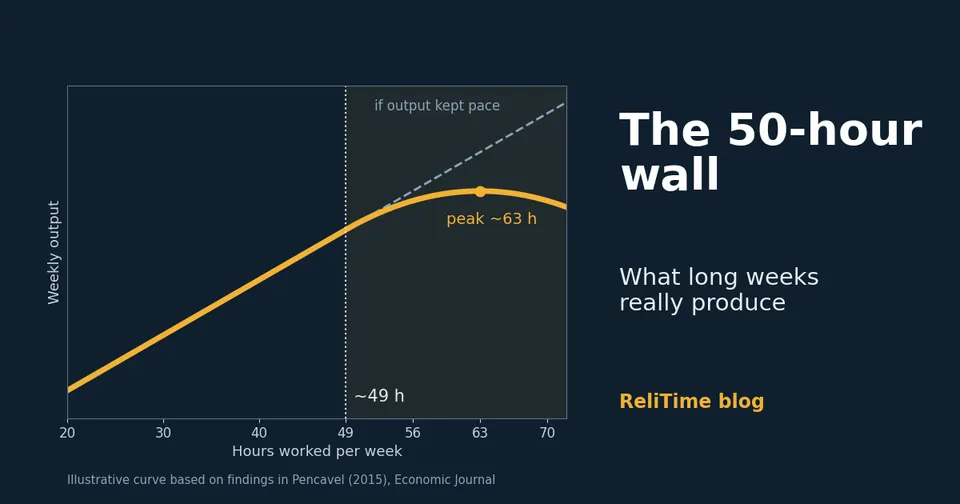
- Up to about 49 hours a week, output rose in step with hours. Each extra hour added about as much as the one before.
- Beyond that point, each extra hour added less. Weekly output peaked at around 63 hours, and a 70-hour week produced little more than a 56-hour week.
- A day of rest mattered on its own. Holding total hours constant, weeks that included Sunday work produced about 10% less. A 48-hour week over six days produced slightly more than a 70-hour week over seven.
In other words, the last 14 hours of a 70-hour week added almost nothing, and the missing rest day made things worse.
Does this apply to engineers?
Not directly, and it's worth being clear about why. These were mostly manual, repetitive jobs, done in wartime, by workers whose output could be counted in shells. Pencavel himself stresses that his sample is small and that the threshold varies with the worker and the type of work.
Knowledge work is harder to measure, and fatigue shows up differently. A tired machinist produces fewer parts. A tired engineer may produce the same number of pages, with more mistakes in them. Those mistakes surface later as review comments and rework, and in assurance work, as errors that someone else has to catch.
The modern evidence Pencavel cites points the same way. A US study of more than 10,000 workers found that, after allowing for other factors, people working at least 12 hours a day had a 37% higher injury hazard rate, and those working at least 60 hours a week a 23% higher rate. A study of hospital nurses linked shifts longer than 12 hours to more errors.
So 49 hours shouldn't be read as a rule for your office. The shape of the curve is the lesson: beyond some point, extra hours buy less and cost more.
What a consultancy can do with this
- Measure actual hours, not planned ones. The munitions researchers separated scheduled hours from time actually worked, and that distinction is where the insight came from. Timesheets that only record what a job was budgeted for can't tell you when people are past the wall.
- Treat sustained long weeks as a planning signal. One heavy week before a deadline is normal. Several in a row usually means an estimate or a resourcing plan was wrong, and the fix belongs in the next estimate, not in more overtime.
- Protect a full day off. In the data, the rest day had an effect separate from total hours.
- Look at quality alongside quantity. Compare review findings and rework on projects that ran long weeks with those that didn't. That is the knowledge-work version of counting shells.
- Be honest in fixed-fee pricing. If a job only fits its budget at 60-hour weeks, the budget is already overrun.
The takeaway
The committee studying these factories concluded that cutting hours would cost little or no output, and Pencavel's analysis largely backs them up. Long hours feel productive, but beyond a point they mostly add fatigue.
The first step for any firm is knowing where its own people sit on that curve. ReliTime records actual hours against every job and phase, so you can see when a team has spent too long past 50 hours a week.